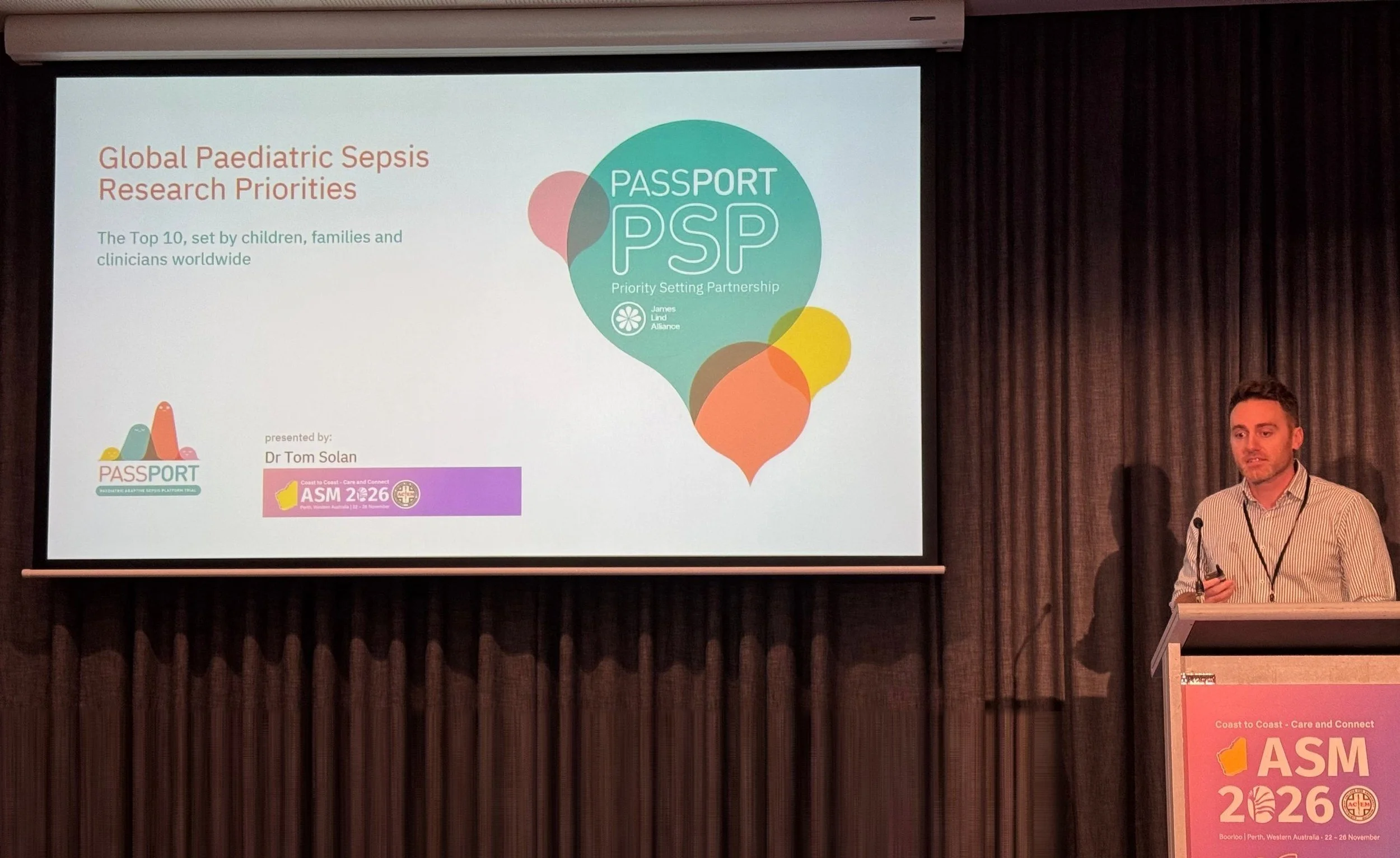
Dr Tom Solan presented the results of the PASSPORT Priority Setting Partnership at the Australasian College for Emergency Medicine Annual Scientific Meeting in Perth on 25 November.
Emergency departments are often where children with sepsis are first seen in hospital, which made the meeting a natural place to share the work. Sepsis is one of the biggest killers of children worldwide. About 25 million children and newborns develop it each year and 3 million die. Yet only three of 61 statements in the 2026 Surviving Sepsis Campaign paediatric guidelines rest on high or moderate quality evidence.
The partnership followed James Lind Alliance methods, which give patients, families and clinicians an equal say in setting research priorities. In the first survey, 607 people from around the world submitted questions they wanted research to answer. A second survey of 405 people from 60 countries narrowed these to a shortlist, with almost half of responses coming from low- and middle-income countries. In September, consumers and clinicians met at a final workshop and ranked the 20 shortlisted questions together to agree a global Top 10.
The talk followed Tom's recent presentation at WFPICCS 2026 in Melbourne.
The Top 10 will be published on the PASSPORT website at the same time as the peer-reviewed paper, alongside a plain-language summary for families.
We thank the children, parents, carers and clinicians who took part, our steering group, James Lind Alliance advisor Toto Gronlund and every partner network that shared the surveys with their communities.