Overview
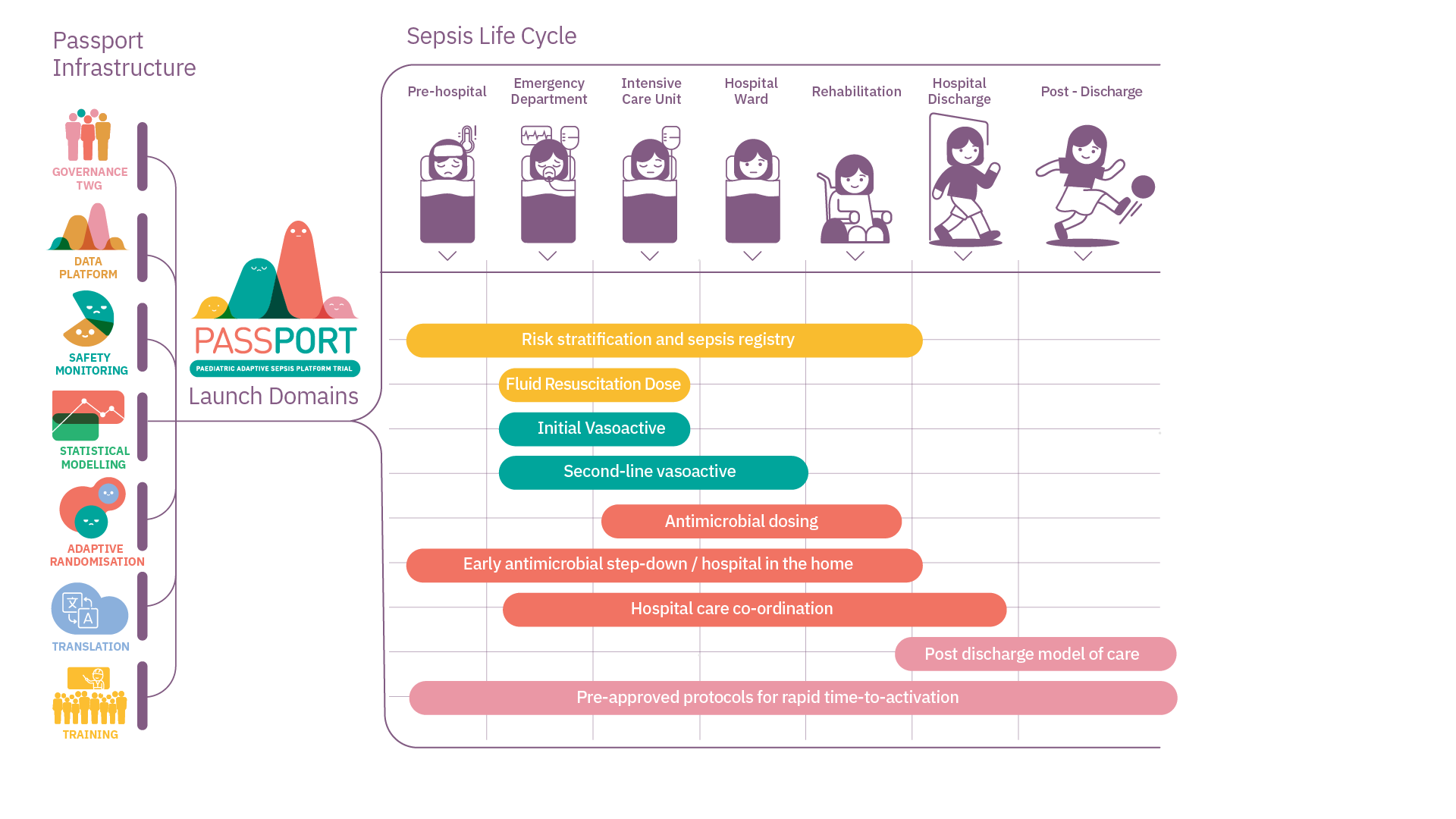
PASSPORT's first two studies ask how much fluid to give children with sepsis and which medicine to start first when fluid is not enough.
Each study within PASSPORT is called a domain. A domain asks one question and compares two or more treatments that are already standard care. A child can take part in more than one domain during the same hospital stay.
Fluid resuscitation
Question: How much fluid should children receive in the first hours of treatment?
Treatments compared: smaller (restrictive) or larger (liberal) amounts
Children included: aged 2 months or older who need fluid through a drip
Status: opens 2027
Initial vasoactive
Question: Which medicine should be used first to support circulation?
Treatments compared: adrenaline or noradrenaline
Children included: aged 2 months or older whose circulation stays poor after fluid
Status: opens 2027
How we measure success
Every study uses the same main measure: whether a child survives, and how many of the first 30 days they spend out of hospital. Each study also tracks the need for organ support, time in intensive care, survival at six months and quality of life.
Future studies
New studies will be added as funding allows. They may cover antibiotics, treatments that calm the immune response, breathing support or recovery. They may also test how hospitals recognise and manage sepsis. The research priorities chosen by families and clinicians will shape the choice.
Fluid resuscitation
In brief: Children with sepsis often need fluid through a drip to restore blood flow. This study compares giving smaller amounts with giving larger ones.
Why it matters
Fluid is one of the first treatments a child with sepsis receives. Yet nobody knows how much is best. Guidelines once advised up to 60mL per kilogram of body weight before other treatment. Current international guidelines suggest 10–20mL/kg at a time, up to 40–60mL/kg in the first hour, but admit the evidence is limited.
Some evidence suggests that more fluid can harm. The FEAST trial found that fluid boluses increased deaths among children in Africa. Other studies link fluid build-up to worse outcomes. A pilot trial in UK emergency departments found no difference in deaths between 10mL/kg and 20mL/kg boluses. Practice therefore varies widely.
What is compared
Restrictive approach
Size of each bolus: 10mL/kg
Between boluses: doctors reassess the child
If more help is needed: start a medicine to support circulation after 20mL/kg
Type of fluid: standard salt solution, as the hospital normally uses
Liberal approach
Size of each bolus: 20mL/kg
Between boluses: doctors reassess the child
If more help is needed: give more fluid or start a medicine after 40mL/kg
Type of fluid: standard salt solution, as the hospital normally uses
The assigned approach applies for six hours after joining, or until the child leaves the emergency department, whichever is sooner. Both approaches are used in hospitals today.
Who can take part
Children aged 2 months or older who meet PASSPORT's entry criteria and whose doctor plans to give at least one fluid bolus for signs of poor circulation.
Children cannot take part if they:
are on dialysis for kidney failure
have heart failure treated with diuretics, cardiomyopathy or myocarditis
have lost a lot of fluid, for example from severe gastroenteritis or diabetic ketoacidosis
have already received more than 20mL/kg of fluid in the previous six hours
joined a PASSPORT study during an earlier admission within the past [30 days / 6 months: confirm]
Size and length
Up to 2,594 children. Simulations suggest the study will usually reach an answer with 1,200–1,750. Recruitment is expected to take about three years.
What else we measure
Whether children need more breathing support, develop kidney injury or new organ problems, and whether they are still in shock after 24 hours.
Initial vasoactive
In brief: When fluid alone does not restore a child's circulation, doctors start a medicine to support it. This study compares the two most common choices, adrenaline and noradrenaline.
Why it matters
International guidelines recommend either adrenaline or noradrenaline as the first medicine, because there is too little evidence to choose. The two work differently. Adrenaline mainly makes the heart pump harder. Noradrenaline mainly tightens blood vessels. Sepsis can weaken the heart or relax the blood vessels, often both at once. Doctors have no reliable bedside test to tell which.
In adults, large trials have found no difference between the two. Children have not been studied in the same way. Choice of medicine varies widely between hospitals in Australia and New Zealand.
What is compared
Adrenaline
What it mainly does: strengthens the heart's pumping
How it is given: continuous infusion into a vein
Dose: set by local hospital guidelines
Noradrenaline
What it mainly does: tightens blood vessels to raise blood pressure
How it is given: continuous infusion into a vein
Dose: set by local hospital guidelines
The assigned medicine is the first one used. Doctors can add other medicines, change the dose or stop it at any time. Only hospitals that stock both medicines and have guidelines for their use can take part.
Who can take part
Children aged 2 months or older who meet PASSPORT's entry criteria, have received initial fluid and still need a medicine to support their circulation.
Children cannot take part if they:
have already started an infusion of one of these medicines (a single dose given by injection is allowed)
have a known reason not to receive either medicine, such as an allergy or a rare adrenal tumour (phaeochromocytoma)
joined a PASSPORT study during an earlier admission within the past 30 days
Size and length
Up to 1,849 children. Simulations suggest the study will usually reach an answer with 980–1,810. Recruitment is expected to take about five years.
What else we measure
Kidney injury, new or worsening organ problems and the number of days children are alive without needing these medicines. We also monitor known side-effects, including irregular heartbeat, problems with intravenous lines and damage to skin or fingers and toes from reduced blood flow.
Many children will join both studies. We will analyse whether the choice of medicine works differently depending on the fluid approach.